
In August 2021, Nick Read, chief executive of Vodafone Plc at the time, did not mince his words while speaking about the India business in an earnings call. Replying to an analyst's question on Vodafone Idea, a venture with the Aditya Birla Group that had piled on huge debts and worrisome losses, Read described it as a highly stressed situation that "they (Vodafone Idea) are trying to navigate... "We, as a group, try to provide them as much practical support as we can, but I want to make it very clear, we are not putting any additional equity into India.''

The central government plans to increase the number of highly beneficial neem trees in the country from the existing one tree for every 50 Indians to one tree for every 10 Indians to meet the rising demand from different sectors for neem oil. Presently, India has 18-20 million neem trees in the country, of which 40-45 per cent are in Uttar Pradesh, followed by Maharashtra, Rajasthan, and Tamil Nadu, among others. To achieve the target, the number of neem trees has to rise to almost 140 million.

Telecom services providers have urged the Ministry of Finance to suspend the universal service obligation (USOF) till the existing corpus is exhausted. In their Budget recommendations, they have also pressed for an exemption from the service tax on "assignment of right to use natural resources" and the slashing of Customs duty on telecom equipment to zero. The Cellular Operators Association of India (Coai), which represents private sector telecom operators Reliance Jio, Bharti Airtel, and Vodafone Idea, called for abolishment of USOF levy.

FSSAI is looking to tap the Airport Health Organisation to ensure that such incidents aren't reported in the future.

Officials hint the visit could finally see a formal defence industrial road map being adopted by both nations.

A few days back, Atul Ganatra, president of the Cotton Association of India, presented a grim scenario of the crop's prospects in the 2024-25 season that starts in October. Addressing the association's annual general meeting, Ganatra said the area under the crop could go down by at least 10 per cent in the coming season due to falling yields and realisation, leading to farmers losing interest. The fear of a decline in acreage comes against the backdrop of India's cotton production probably falling to its lowest in a decade, according to estimates.

'We have informed the government multiple times that the situation in the US and India are different.' 'Here, there will be a 500 MHz gap in the frequencies which will safely allow aviation without interference.'

While the market for satellite broadband currently is small, the potential is large as an estimated 30 per cent of the country does not have reliable terrestrial broadband services.

'Given that the situation is quickly escalating, such attacks will affect the flow of crude in the short term from West Asia' Subhayan Chakraborty and Dhruvaksh Saha report.

Chief Economic Advisor (CEA) V Anantha Nageswaran considers absolute poverty a more direct and pressing concern for India. He argues that inequality is a relative concept. Simultaneously, with formerly economically deprived sections joining the ranks of the middle class, policy attention needs to extend beyond 'roti, kapda, makaan' to keep the growth engine up and running.

Officials said the bill has provided a clear legal basis for spectrum allocation, which till now was allocated or auctioned by the government based on the interpretation of various laws and judgements.

India is expected to ramp up its purchase of crude oil from the United Arab Emirates (UAE) in the coming months following discussions between the two countries on the sidelines of the ongoing COP28 summit in Dubai, multiple sources in the know said. The UAE has historically been India's third-largest source of crude. It has suffered the largest drop in shipments since Indian refiners began to binge on Russian crude in 2022.

The next spectrum auction will be held in late February 2024 and the reserve price for most bands will remain the same as the 2022 auction, department of telecommunications (DoT) officials have said. The government expects operators to go for low bands beginning in 600 megahertz (MHz), licences for many of which are lapsing soon. Back in September 2021, the government had decided that spectrum auctions should be held annually.

If states have to fall in line with MSPs declared by political parties, they will have to do so in violation of central order or bear the full expense of the surplus procured at above MSP rates.
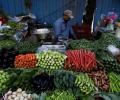
Higher growth in vegetable demand relative to supply in the recent past has led to an upward trend in inflation, with spikes becoming more frequent. A study by rating agency Crisil found that vegetable inflation has been the most volatile in the food category, in fact. Inflation volatility is detrimental for both consumers and farmers and also sidetracks policymakers in the short term, necessitating frequent and repeated price-smoothing measures.

The three-day India Mobile Congress (IMC) will showcase the widening convergence of telecom with new domains, such as semiconductors and deep tech, P Ramakrishna, the forum's chief executive officer, said on Tuesday. With more than 250 global and domestic exhibitors, the seventh edition is expected to draw more than 100,000 visitors this year, he said. There will also be over 5,000 CXO-level delegates and more than 350 speakers.

The government's decision to impose a 20 per cent export duty on parboiled rice and a $1,200 per tonne minimum export price (MEP) on basmati rice has pulled down overseas shipments of the former by almost 83 per cent and around 30 per cent of basmati exports in a month. Data sourced from various trade agencies and shippers showed that between August 25 and September 20, export of basmati rice has shrunk from 342,605 tonnes in 2022 to around 241,083 tonnes in 2023. Similarly, export of parboiled rice, after the imposition of 20 per cent duty during the same period, has dropped from 1.16 million tonnes in 2022 to just around 204,190 tonnes in 2023.

Keen to capitalise on the growing geopolitical support from African nations after the recently concluded G20 Summit, India is working with the African Union to hold the fourth India-Africa Forum Summit later this year in Kenya's Nairobi, sources said. Prime Minister Narendra Modi is expected to attend the mega meet along with as many as 50 African leaders, they added. First held in New Delhi in 2008, the India-Africa Forum Summit marked India's initial diplomatic efforts to seek a comprehensive partnership with the African bloc of nations as a whole, at a time when China had begun its own outreach.
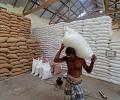
Amid the ongoing festival season and ahead of the elections for five state assemblies, the Centre is closely monitoring inflation, particularly in food items, to enable it to take steps to increase their supplies. "There is a complete no-nonsense attitude when it comes to food inflation, and instructions have been issued at all levels to be very sensitive to any possible price movements in any commodity," a senior official explained. Sources have said that all departments dealing with food items have been instructed to keep a close eye on all commodities and maintain a weekly record of their price movements.

The Centre, for the first time, has initiated a draft proposal for setting up an All India Institute of Medical Sciences (AIIMS)-like institute of national importance for animal health, education and research in Delhi to be called the All India Institute of Veterinary Sciences (AIIVS).
